
A Data Breach Is a Financial Risk
When a breach hits the news, most coverage focuses on how attackers got in. But the real financial damage starts after they get in.
A data breach is a financial event. It triggers fines, lawsuits, customer compensation, and lost revenue. At scale, it can threaten the business itself.
Two kinds of damage
Breach damage usually falls into two categories.
Direct damage is what shows up on the invoice: regulatory fines, class-action settlements, customer compensation, incident response, credit monitoring, and legal fees. Change Healthcare affected nearly 193 million people and pushed UnitedHealth’s 2024 cyberattack impact into the $2.3B–$2.45B range [1][2]. SK Telecom exposed data affecting roughly 27 million users and was fined KRW 134.79 billion — the largest single penalty in Korean history [3].
Indirect damage is what shows up everywhere else: brand erosion, customer churn, revenue decline, and market-cap loss. SK Telecom’s FY2025 operating profit fell 41.4 percent year-over-year, and roughly 650,000 subscribers left after its breach — losses that dwarfed the fine itself [4].
Damage becomes enormous at scale
A breach involving more than one million records creates serious financial impact even before indirect damage is counted. IBM’s 2024 data shows the pattern clearly: the global average breach costs USD 4.88 million, but a breach involving one million records averages USD 42 million, and breaches involving 50 million or more records average USD 375 million — roughly 75 times the global average [5].
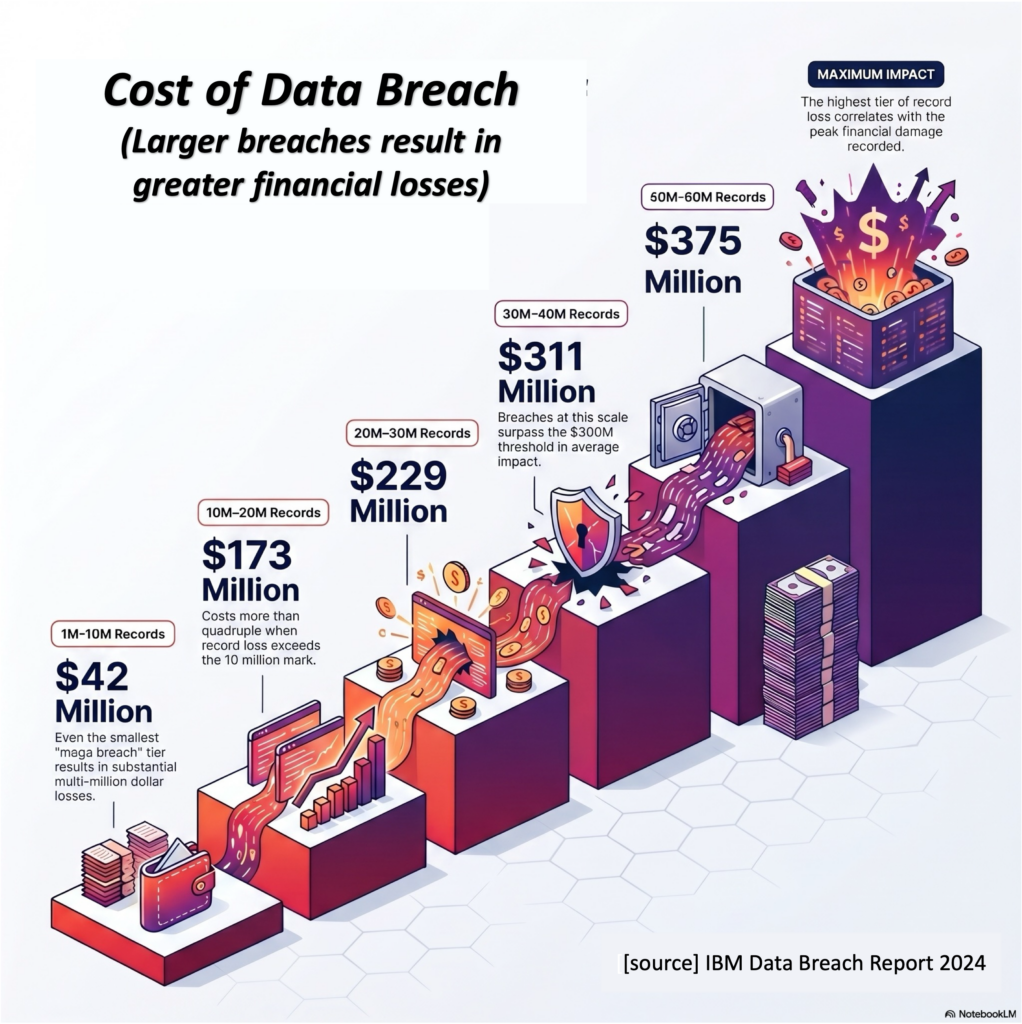
Cost of Mega Breaches(IBM Data Breach Report 2024)
The pattern is simple: the more records exfiltrated, the higher the cost.
Recent cases make this even clearer. National Public Data filed for bankruptcy after a massive identity-data breach involving Social Security numbers and billions of exposed records [6]. 23andMe also entered bankruptcy proceedings after years of business pressure, with its breach adding class-action, settlement, and genetic-data governance risk [7]. The lesson is not that every breach causes bankruptcy. The lesson is that large-scale exposure can turn cybersecurity into a material business risk.
The lever is exposure volume
Most enterprises already hold personal data on more than a million people — customers, users, members, patients, or employees. Many have already crossed the scale threshold where a single breach can become a board-level financial event.
That means reducing breach financial risk is no longer only about preventing intrusion. It is also about limiting how much data becomes exposed when intrusion happens.
Data breach risk is not only about whether attackers get in. It is about how much data they can expose once they are in.
How Datarmor helps
We are building BreachLocker, a Bounded Exposure platform for Data Exfiltration Resilience for the AI era.
BreachLocker keeps sensitive data encrypted and caps exposure by policy, not by trust. Unlike perimeter or access-control approaches, it assumes the attacker may already be inside — and structurally limits how much plaintext data can ever leave, even against AI-weaponized adversaries operating at machine speed.
If you want to reduce breach financial risk by limiting plaintext exposure, contact us.
References
[1] Reuters (2025), “Hack at UnitedHealth’s tech unit impacted 192.7 million people, US health dept website shows.”
[2] Forbes (2024), “UnitedHealth Group Cyberattack Costs To Eclipse $2.3 Billion This Year.”
[3] Reuters (2025), “South Korea agency fines SK Telecom $97 million over major data leak.”
[4] SK Telecom Newsroom (2026), “SK Telecom Announces FY 2025 Results.”
[5] IBM (2024), “Cost of a Data Breach Report 2024.”
[6] TechCrunch (2024), “National Public Data, the hacked data broker that lost millions of Social Security numbers and more, files for bankruptcy.”
[7] Reuters (2025), “DNA-testing firm 23andMe files for bankruptcy, CEO resigns.”