This report compiles major data breach incidents publicly disclosed between June 1 and June 30, 2026. Incidents are de-duplicated and selected on the basis of disclosure date (the date the incident was publicly reported), not the date the breach actually occurred. All incidents involving more than one million affected individuals are included, along with a selection of secondary incidents that are strategically significant for their attack technique, target profile, or wider implications.
The Attack Vector taxonomy used in this report follows the categorization framework adopted by the IBM Cost of a Data Breach Report. Each Attack Vector is mapped to the corresponding MITRE ATT&CK techniques to provide threat-informed context for defenders.
Executive Summary
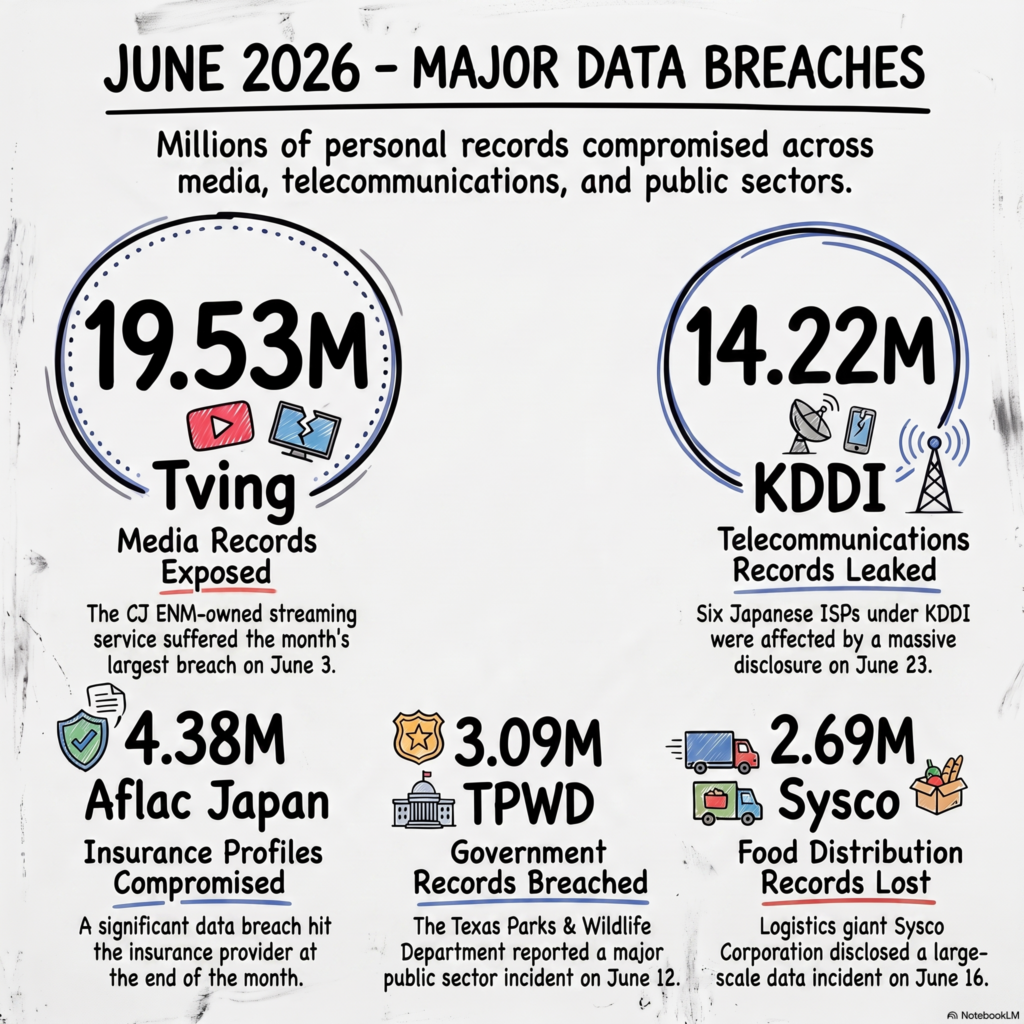
June 2026 was defined by three structural themes: the industrialization of extortion-driven data theft against enterprise SaaS and ERP platforms, the compounding risk of shared and third-party infrastructure, and the recurring failure to protect developer credentials — hardcoded cloud keys and OAuth tokens — that gate access to entire data estates. South Korea’s Tving suffered the month’s largest disclosed breach (19.53 million individuals) after an AWS access key left hardcoded in a GitHub repository let an attacker query its database directly. A single Oracle PeopleSoft zero-day (CVE-2026-35273) exploited by ShinyHunters cascaded across more than 100 organizations, while a shared email backend at Japan’s KDDI turned one software flaw into a 14-million-account exposure across six ISPs. The insurance sector was hit repeatedly, with Aflac Japan, AssuranceAmerica, and the NAIC all disclosing incidents in the same month. The period also surfaced a new class of AI-specific risk: hackers hijacked roughly 20,000 Instagram accounts simply by instructing Meta’s AI support chatbot to reset passwords.
Top Incidents by Exposure Volume
| Rank | Incident | Scale | Sector | Disclosed |
|---|---|---|---|---|
| 1 | Tving (CJ ENM) | 19.53M | Media / OTT Streaming | Jun 3 |
| 2 | KDDI (six Japanese ISPs) | 14.22M | Telecommunications | Jun 23 |
| 3 | Aflac Life Insurance Japan | 4.38M | Insurance | Jun 30 |
| 4 | Texas Parks & Wildlife Dept. (TPWD) | 3.09M | Government / Public Sector | Jun 12 |
| 5 | Sysco Corporation | 2.69M (61M records claimed) | Food Distribution | Jun 16 |
| 6 | DentaQuest (Sun Life) | 2.6M | Healthcare / Dental Benefits | Jun 2 |
| 7 | California Water Service (Cal Water) | 2M | Utilities / Water | Jun 11 |
| 8 | Xsolis | 1.4M | Healthcare Technology (AI) | Jun 5 |
| 9 | iFood | 1.2M (43.8M claimed) | Food Delivery | Jun 3 |
| 10 | AssuranceAmerica | 1.1M+ | Insurance | Jun 17 |
Note on TikTok: A threat actor claimed 2.4 billion TikTok records on June 11, but security researchers assessed the data as most likely repackaged infostealer logs rather than a direct breach of TikTok. Because the claim is unverified and disputed at the source, it is excluded from the ranking above and discussed in the body as a claim-only event.
Most Frequently Exposed Data Types
The categories below are ordered by the total volume of exposure across the month’s incidents (confirmed figures only). Totals overlap, since a single incident typically exposes several data types at once.
- Names and contact information — roughly 52 million individuals. Email addresses, phone numbers, and physical/service addresses were present in all ten of the million-plus incidents (Tving 19.53M, KDDI 14.22M, Aflac Japan 4.38M, TPWD 3.09M, Sysco 2.69M, DentaQuest 2.6M, Cal Water 2M, Xsolis 1.4M, AssuranceAmerica 1.1M+, iFood 1.2M).
- Account credentials — roughly 34 million accounts. Email-password pairs at KDDI (14.22M, protection level undisclosed), one-way-hashed passwords for 19.53M Tving users, and roughly 20K hijacked Instagram accounts. Credentials at this scale feed directly into credential-stuffing and account-takeover campaigns across unrelated services.
- Non-rotatable identity-verification identifiers — 19.53 million individuals. Korea’s Connecting Information (CI) and Duplication Information (DI), the “digital resident-registration number” derived from the national ID, exposed in the Tving breach. Unlike a password, these cannot be reissued once leaked, making this the most durable harm of the month despite coming from a single incident.
- Government-issued identifiers — roughly 9.7 million individuals. Driver’s license and passport numbers (TPWD 3.09M), government-issued IDs (DentaQuest 2.6M), Social Security numbers (Xsolis 1.4M; AssuranceAmerica 1.1M+, plus driver’s license and tax ID), and Brazilian CPF taxpayer numbers (iFood 1.2M).
- Insurance and financial account information — roughly 8.3 million individuals. Policy, claims, and account data at Aflac Japan (4.38M, including premium-transfer bank accounts for 230K), health-insurance and Medicaid IDs at DentaQuest (2.6M), and policy/claims data at AssuranceAmerica (1.1M+). Tving’s refund bank-account numbers (19.53M) were also taken but were stored encrypted.
- Health and medical information — roughly 4 million individuals. Health-insurance details and medical-treatment records (DentaQuest 2.6M, Xsolis 1.4M) and pseudonymized clinical-trial data for ~11,500 Novo Nordisk trial participants.
- Enterprise CRM and support-case data — 2.69 million confirmed at Sysco, plus unquantified exposure across the dozen-plus victims of the Klue/Salesforce campaign (LastPass and others) and ServiceNow instance data. Low in headline volume, but support-case history is prime raw material for convincing spear-phishing.
- Corporate and intellectual property — measured in terabytes rather than people: source code, drug compound libraries, and trained AI models at Novo Nordisk (~1.3 TB) and Apple/Tesla manufacturing documents at Tata Electronics (630 GB).
Leading Attack Vectors
Vectors are ranked by the total confirmed exposure of the incidents in which each vector played a defining role. Because most incidents chain multiple vectors (e.g., a supply-chain foothold followed by credential abuse), an incident can appear under more than one category and the totals overlap.
- Compromised credentials — roughly 24.8 million confirmed, the largest vector of the month by volume. Tving’s 19.53M is the one large incident with a confirmed credential vector (an AWS access key hardcoded in a GitHub repository). The Sysco (2.69M) and DentaQuest (2.6M) datasets are grouped here because both are attributed to ShinyHunters, whose 2026 campaign characteristically abuses stolen or fraudulently authorized credentials — but neither company disclosed its specific initial-access method, so the attribution rather than a confirmed vector places them in this category. Also credential-driven, though unquantified: FulcrumSec’s stolen GitHub token at Novo Nordisk, the Icarus group’s abuse of a single legacy OAuth credential at Klue to reach a dozen-plus vendors’ Salesforce environments, and the plaintext admin credentials used to pivot inside Cal Water.
- Third-party vendor and supply chain compromise — roughly 21.4 million exposed through a vendor, shared platform, or SaaS integration rather than the victim’s own perimeter. KDDI’s shared multi-tenant email backend propagated one flaw to six ISPs (14.22M); TPWD’s license vendor (3.09M); Sysco’s Salesforce environment (2.69M); and Xsolis, itself a vendor, cascading to 600+ hospital clients (1.4M). Add the unquantified Klue/Salesforce campaign and the 100+ organizations running the exploited PeopleSoft software, and third-party exposure rivals credentials as the month’s defining structural risk.
- Vulnerability exploitation — roughly 16.7 million. KDDI’s third-party software flaw (14.22M), Cal Water’s internet-exposed RTKBase instance (2M customer base), the Oracle PeopleSoft zero-day CVE-2026-35273 across 100+ organizations (individual counts mostly undisclosed; ~455K confirmed at the University of Nottingham alone), and ServiceNow’s unauthenticated API endpoint (scale undisclosed).
- Others / undisclosed initial vector — roughly 6.7 million. Aflac Japan (4.38M), AssuranceAmerica (1.1M+, an employee-targeted intrusion whose specific method was not disclosed), and iFood (1.2M) confirmed breaches without disclosing the entry method, as did London Hydro and Tata Electronics. Roughly a seventh of the month’s confirmed exposure has no publicly attributed root cause — itself a transparency problem for defenders trying to learn from these incidents.
- Phishing — Xsolis (1.4M) is the one large incident this month with a confirmed phishing initial-access vector. (AssuranceAmerica’s 1.1M+ employee-targeted intrusion is often assumed to be phishing, but its method was not disclosed, so it is not counted here.) Phishing remains the standing entry point for healthcare and insurance intrusions even when it is a small share of headline volume.
- System error / misconfiguration and denial-of-service — largely unquantified this month: CBSE’s misconfigured cloud storage bucket and the June 2 DoS-plus-data-theft wave (~2M students claimed, disputed), and the authentication misconfiguration at the root of the ServiceNow exposure. AI support-agent abuse (Meta/Instagram, ~20K accounts) contributed the smallest confirmed volume of any vector, but is the fastest-emerging class and scales with AI adoption.
Notable Attack Patterns
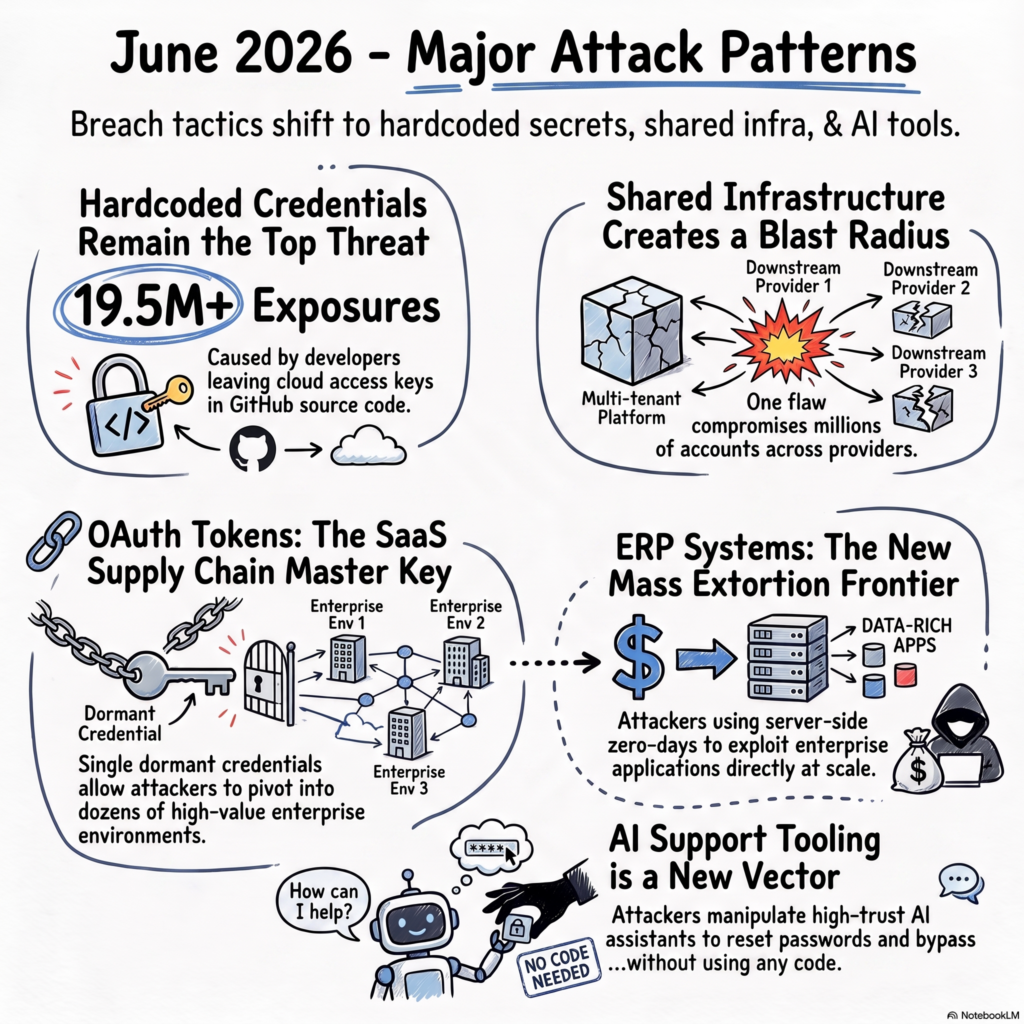
Patterns are ordered by the confirmed exposure volume attached to each; the final entries carry the smallest headline numbers but the fastest-growing strategic weight.
- Hardcoded developer credentials as the single point of catastrophic failure (exposure: 19.53M+, the month’s largest). Tving’s breach and a parallel Korean incident (Day1Company) both traced back to cloud credentials left hardcoded in GitHub source code. Once an attacker retrieves an AWS access key from a repository, the database and its encryption are irrelevant — the key opens the front door with legitimate privileges. The recurrence of this decades-old anti-pattern (echoing Toyota’s 2017–2022 T-Connect exposure) shows that secrets management, not perimeter defense, is where these breaches are won or lost.
- Shared-infrastructure blast radius (exposure: 14.22M). KDDI’s breach demonstrated how a single vulnerability in a consolidated, multi-tenant email platform instantly becomes the problem of every downstream ISP — one flaw, six providers, 14 million accounts.
- IT-to-OT pivots in critical infrastructure (exposure: ~2M customers at risk; 5 GB leaked). At Cal Water, an internet-exposed GPS correction tool (RTKBase) with plaintext credentials served as the pivot point into the customer billing environment, underscoring weak segmentation between operational support tools and sensitive data systems in the utility sector — and, given Handala’s history of follow-on wiper attacks, a possible precursor to worse.
- ERP as the new frontier for mass extortion (exposure: 100+ organizations; individual counts largely undisclosed, ~455K confirmed at one university alone). ShinyHunters’ pivot from SaaS social engineering to a server-side zero-day in on-premises Oracle PeopleSoft (CVE-2026-35273) marked a shift toward directly exploiting data-rich enterprise applications at scale, hitting 100+ organizations before Oracle’s advisory.
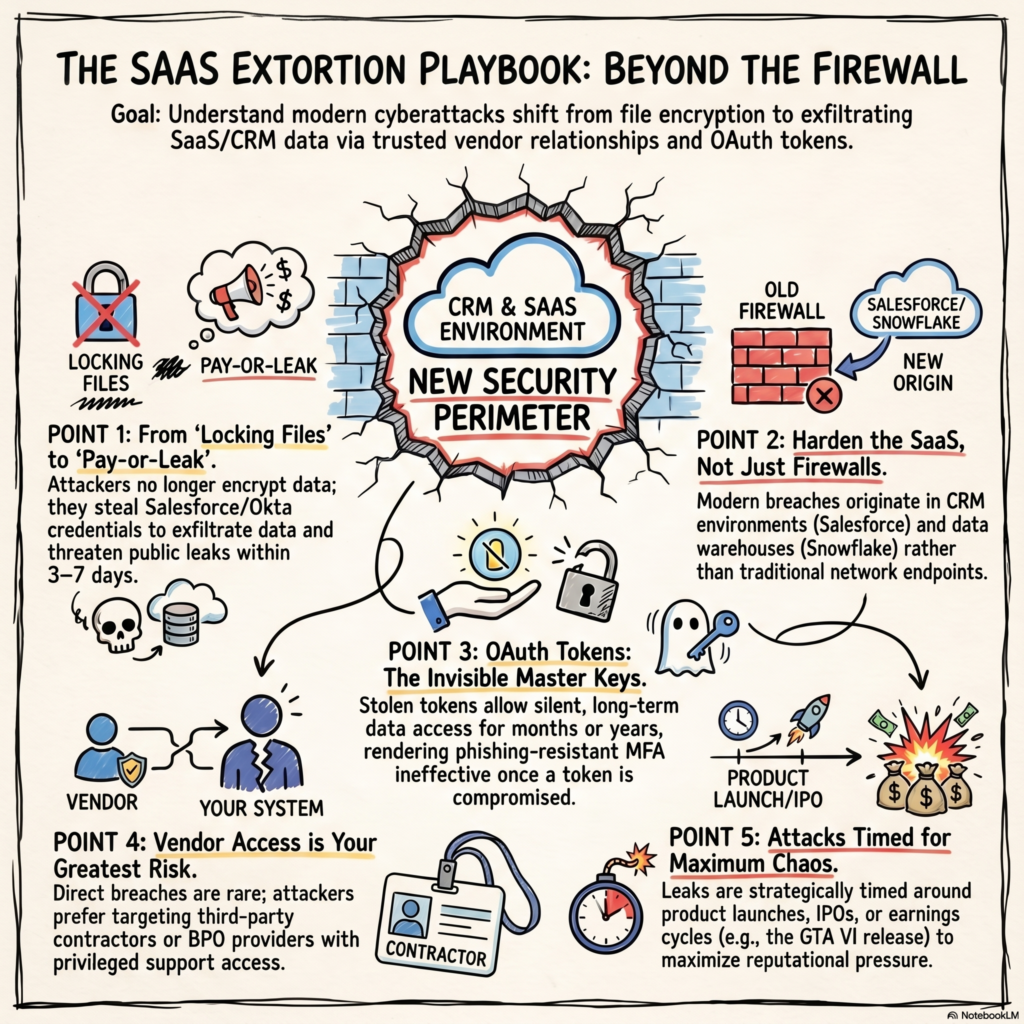
- OAuth tokens as the master key to SaaS supply chains (exposure: a dozen-plus vendors’ Salesforce datasets, unquantified). The Klue incident showed how a single dormant OAuth credential — created for a 2022 pilot and never revoked — let the Icarus group harvest tokens for Klue’s customers and pivot into the Salesforce environments of LastPass, BeyondTrust, HackerOne, Recorded Future, Tanium, and others at once. This is the direct successor to the Salesloft/Drift and Gainsight campaigns: the target is no longer the enterprise, but the integration that sits between it and its SaaS platform.
- Intellectual property and AI models as extortion targets (exposure: terabyte-scale IP; ~11.5K trial participants). The Novo Nordisk and Tata Electronics incidents show extortion groups increasingly targeting trade secrets, source code, drug compound data, and even trained AI models — assets that, unlike credentials, cannot be rotated or re-secured after theft. Person-counts understate the damage: the stolen asset here is competitive position itself.
- Abuse of AI-powered support tooling (exposure: ~20K accounts — the smallest of the month, but the newest vector class). The Meta/Instagram account takeovers required no malware, no code, and no credentials — attackers simply asked an AI support assistant to add an email address and reset the password. As enterprises hand more high-trust functions to AI agents, this category’s ceiling rises with every deployment.
Incident Details
1. Tving (CJ ENM)
Affected organization: Tving, South Korea’s largest homegrown OTT streaming platform, operated by CJ ENM. Tving has roughly 5 million paid subscribers and 8.8 million monthly active users, and holds identity data accumulated through mergers (Seezn, Wavve) and partner integrations (CJ ONE, telecom bundle plans).
Impact and significance: This was the single largest disclosed breach of the month and the fourth-largest personal-data breach in South Korean history (after Coupang, SK Telecom, and Nate/Cyworld). The government’s investigative panel put the final count at 19,530,000 individuals — nearly four times Tving’s paid-subscriber base, prompting a regulatory inquiry into why so much data (including that of withdrawn and dormant accounts, which the Personal Information Protection Act requires be destroyed) was retained. The exposure is especially damaging because it included Connecting Information (CI) and Duplication Information (DI) — Korea’s national-ID-derived identity-verification identifiers, often called the “digital resident-registration number,” which cannot be changed once compromised and can be combined with other data to enable identity theft, account takeover, and financial fraud. The incident also drew scrutiny because Tving’s information-security investment had fallen roughly 20% year over year, and because the intrusion was not detected by its own monitoring but only surfaced through a database CPU-utilization spike.
Threat actor: Not attributed (an unidentified external attacker).
Attack overview: According to Tving’s incident report to Korea’s KISA, the attacker obtained an AWS access key that had been hardcoded into source code in a GitHub repository, then used that key to connect directly to the database server and execute SQL queries (read, modify, delete). The intrusion began at 18:01 on May 30; Tving noticed a DB-server CPU spike to 100% and confirmed unauthorized access and query execution, recognized the incident at 15:09 on May 31, filed with KISA at 15:08 on June 1 (one minute inside the 24-hour statutory deadline), and disclosed to users on June 3. Remediation included revoking the compromised AWS access key, deactivating the attacker’s credentials, removing and rotating the hardcoded GitHub credentials, and changing AWS access-control policies. A parallel Korean incident at education firm Day1Company, disclosed June 11, stemmed from a similar theft of a GitHub master-account key, underscoring a systemic secrets-management problem.
Attack Vectors: – Compromised credentials (T1078 – Valid Accounts; T1552.001 – Unsecured Credentials: Credentials In Files): An AWS access key hardcoded into GitHub-hosted source code was retrieved by the attacker and used to authenticate to the database with legitimate, high-privilege access. This is the confirmed initial-access vector.
How the AWS key was exposed in the GitHub repository (public repository, leaked developer account, or otherwise), and whether the attacker took any further action beyond the database queries, were not disclosed. The full attack chain beyond initial access remains under investigation.
Data exposed: User ID, name, date of birth, gender, CI (Connecting Information) and DI (Duplication Information), mobile phone number (last 4 digits encrypted), email (local-part encrypted), refund bank-account number (encrypted), password (one-way hashed), and service-usage information.
Scale: 19,530,000 individuals (final government tally; initial provisional estimate was 13 million). Investigation ongoing.
2. KDDI Corporation (six Japanese ISPs)
Affected organization: KDDI Corporation, one of Japan’s largest telecommunications operators, plus five additional ISPs that rely on its shared email system: NIFTY, BIGLOBE, J:COM (JCOM), STNet (Pikara), Chubu Telecommunications (Commufa), and KDDI Web Communications.
Impact and significance: The breach exposed the email addresses and passwords for up to 14.22 million accounts across six providers — the second-largest disclosed exposure of the month. Its significance lies in the shared-infrastructure architecture: because KDDI operates a centralized email backend used by multiple ISP subsidiaries and partners, a single flaw in one component immediately compromised all six tenants at once. This is the same structural logic that amplified the Kaseya and MOVEit incidents. KDDI has not named the vulnerable third-party software or specified what percentage of passwords were stored in plaintext versus hashed form, leaving the true credential risk uncertain.
Threat actor: Not publicly attributed.
Attack overview: KDDI detected unauthorized access to its shared email system on June 17 and immediately blocked the attacker and modified the system. Investigation determined that attackers exploited a vulnerability in unnamed third-party software integrated into the email platform. KDDI notified Japan’s Personal Information Protection Commission and the Ministry of Internal Affairs and Communications and disclosed publicly on June 23.
Attack Vectors: – Vulnerability exploitation (T1190 – Exploit Public-Facing Application): KDDI stated that attackers exploited a flaw in third-party software integrated into its email system. The software was not named, no CVE was cited, and how the exploitation led to exposure of up to 14.22 million credentials was not disclosed. – Third-party vendor & supply chain compromise (T1195 – Supply Chain Compromise; T1199 – Trusted Relationship): The vulnerable component was third-party software embedded in a shared platform, and the shared architecture propagated the compromise across six separate ISP operators simultaneously.
Data exposed: Email addresses and passwords (some stored in hashed or encrypted form; the proportion in plaintext was not disclosed). The figure includes current, former, and long-inactive accounts.
Scale: Up to 14.22 million email accounts (worst-case estimate; investigation ongoing).
3. Aflac Life Insurance Japan
Affected organization: Aflac Life Insurance Japan Ltd., a wholly owned subsidiary of Aflac Incorporated (the largest supplemental insurance provider in the U.S.).
Impact and significance: Attackers exfiltrated personal data for approximately 4.38 million customers and agents from Aflac Japan’s policyholder portal, including premium-transfer bank account information for roughly 230,000 individuals. This is the second major Aflac breach confirmed in roughly a year (following a June 2025 incident at Aflac’s U.S. business affecting more than 22 million individuals) and adds to a wave of attacks against the insurance sector in June. The intrusion persisted for ten days before detection.
Threat actor: Not publicly attributed at time of disclosure.
Attack overview: Aflac Japan said an unauthorized third party accessed certain systems multiple times between June 15 and June 25, 2026. The company discovered the intrusion on June 25 after a surge in access traffic increased system load, then suspended affected systems to contain it. Aflac disclosed the incident in a Form 8-K filed with the U.S. SEC on June 30. The incident was confined to Aflac Japan and did not affect U.S. operations.
Attack Vectors: – Not disclosed. Aflac Japan attributed the breach to repeated unauthorized access to its policyholder portal between June 15 and June 25 but did not disclose the initial-access method or any subsequent steps in the attack.
Data exposed: Names, addresses, phone numbers, dates of birth, gender, security information, and insurance account information; premium-transfer bank account information for approximately 230,000 individuals. No credit card data was accessed.
Scale: Approximately 4.38 million customers and agents.
4. Texas Parks & Wildlife Department (TPWD)
Affected organization: The Texas Parks and Wildlife Department, via a third-party vendor that operates its hunting and fishing license sales system. The vendor was not named.
Impact and significance: The breach exposed data for 3,087,721 individuals who purchased hunting and fishing licenses, including highly sensitive government identifiers — driver’s license information and passport numbers. Its significance lies in the government third-party vendor exposure and the nature of the data: driver’s license and passport numbers cannot be changed like a password, creating a long-tail identity theft risk. Threat intelligence reporting linked the same threat actor to a similar breach at Virginia’s Department of Wildlife Resources, suggesting a small number of shared SaaS vendors serving multiple state wildlife agencies represent a systemic exposure.
Threat actor: Not officially confirmed. A dark-web actor using the handle “Wikkid” reportedly advertised a TPWD dataset before official disclosure.
Attack overview: Texas Cyber Command detected the incident and TPWD was notified on May 13, 2026. TPWD published a formal Notification of Data Security Incident on June 12 and made a broader public disclosure on June 18. The investigation did not determine the initial compromise date, the entry method, or the duration of unauthorized access.
Attack Vectors: – Third-party vendor & supply chain compromise (T1195 – Supply Chain Compromise; T1199 – Trusted Relationship): The attacker reached customer profile data through the third-party vendor that processes license sales. How the vendor itself was breached — the initial-access method, the compromise date, and the dwell time — was not determined or disclosed.
Data exposed: Driver’s license information, passport numbers (where provided), email addresses, phone numbers, and residential addresses. TPWD stated that Social Security numbers, dates of birth, and financial/credit card information were not obtained, and that records of individuals under 18 were not involved.
Scale: 3,087,721 individuals.
5. Sysco Corporation
Affected organization: Sysco Corporation, the world’s largest food distribution company, operating 340+ distribution facilities and supplying roughly 750,000 customer locations (restaurants, healthcare facilities, schools, and hospitality businesses) across 10 countries.
Impact and significance: The headline figures for this incident measure two different things and carry very different levels of verification. ShinyHunters’ leak-site listing (June 16) claimed “over 61 million Salesforce records across several tables” — a raw row count spanning contacts, cases, tasks, and feedback entries, posted with no proof samples. Have I Been Pwned, after the group published the actual dataset, deduplicated it to 2,691,852 unique email addresses belonging to staff and customers — the only independently verified figure, and the best available proxy for distinct affected individuals. HIBP is the de facto industry standard for breach verification (its data feeds are used by the FBI and the UK NCSC, and services such as Firefox Monitor and 1Password build on it); before loading a dataset, its process checks the data against prior breaches to rule out recycling and verifies samples with affected subscribers before attributing it to a source. The HIBP figure should nonetheless be read as a floor rather than a ceiling: it counts only unique email addresses in the dataset the group chose to publish, so records without an email address — or any stolen data withheld from publication — are not reflected. The two figures are not mathematically contradictory (a CRM serving 750,000 customer locations can plausibly hold 61 million rows tied to ~2.7 million unique contacts), but the 61 million figure exists solely on the attacker’s say-so, and ShinyHunters has a documented pattern of inflated claims: its 42-million-record Charter claim in May deduplicated to 4.9 million on HIBP, and in the NAIC case this same month the group itself revised its claim downward, blaming an AI-generated misinterpretation of the data. Sysco has made no public statement, filed no incident 8-K (its June–July SEC filings concern the Jetro Restaurant Depot merger), and did not respond to media inquiries about either the Qilin or ShinyHunters claims. The proposed class action filed June 24 cites the 61 million figure, but this repeats the attacker’s claim rather than establishing it. The incident is also notable because Sysco was named by two separate threat operations in quick succession — the Qilin ransomware gang claimed a network breach in early May and published samples (customer pricing lists, delivery invoices, tax documents dated 2021–2026), weeks before the ShinyHunters listing — suggesting multiple unresolved access issues across different attack surfaces (on-premises infrastructure vs. SaaS CRM).
Threat actor: ShinyHunters (also tracked as UNC6240). Separately, the Qilin ransomware gang made an earlier, distinct claim in May.
Attack overview: The confirmed facts are limited: ShinyHunters listed Sysco on June 16 with a June 18 contact deadline, then published a dataset after the demand went unmet, which HIBP indexed on June 28. The initial-access method for Sysco was not disclosed and has not been confirmed. As background on the actor (not as a description of the Sysco intrusion), ShinyHunters’ broader 2026 Salesforce campaign has typically used one of two entry methods — voice-phishing employees into authorizing a malicious connected app to mint an OAuth token, or scanning code repositories for committed API keys and tokens — followed by REST API enumeration and looped queries to bulk-exfiltrate CRM records.
Attack Vectors: – Compromised credentials (Others — specific vector not disclosed): Sysco did not disclose how the data was accessed. The incident is grouped under credential abuse because it is attributed to ShinyHunters, whose campaign characteristically abuses OAuth tokens and dormant API credentials against Salesforce — but this is an attribution-based inference, not a confirmed vector for Sysco. – Third-party vendor & supply chain compromise (T1199 – Trusted Relationship): The published data reportedly originated from Salesforce, a trusted third-party SaaS platform; this too rests on the leaked dataset and the group’s known targeting rather than a Sysco disclosure.
Data exposed: Names, email addresses, usernames, phone numbers, physical addresses, employers, internal job titles, internal account IDs, and customer feedback records — a corporate contact directory at scale. Because the affected population is overwhelmingly business contacts, the primary downstream risk is business email compromise, supplier/invoice fraud, and highly credible spear-phishing referencing real Sysco accounts and orders, rather than consumer identity theft.
Scale: 2,691,852 confirmed unique email addresses per HIBP deduplication of the published dataset (the attacker claims 61 million Salesforce records; note the units differ — the claim counts table rows, the confirmed figure counts unique individuals — and the claim remains unverified by Sysco or any third party).
6. DentaQuest (Sun Life)
Affected organization: DentaQuest, one of the largest dental and vision benefits administrators in the United States and a subsidiary of Sun Life Financial. It administers Medicaid, CHIP, Medicare Advantage, and commercial plans, serving roughly 32–35 million Americans.
Impact and significance: The breach exposed personal and health information for approximately 2.6 million individuals. Its significance is heightened by the population affected: DentaQuest’s membership base includes a large proportion of Medicaid enrollees — low-income individuals and families who often have limited access to credit-monitoring tools and fewer resources to respond to identity theft. If confirmed at scale, the incident ranks among the largest U.S. health-data breaches of the year, and it drew scrutiny over the delay between the underlying compromise and public notification.
Threat actor: ShinyHunters.
Attack overview: ShinyHunters listed DentaQuest on its dark-web leak site in May 2026, claiming to have stolen more than 234 GB of data. After negotiations reportedly failed, the group published the full 234 GB archive. DentaQuest confirmed the breach on June 2, acknowledging unauthorized access to a limited portion of its network. The specific initial-access method and the exfiltration technique were not disclosed by DentaQuest.
Attack Vectors: – Third-party vendor & supply chain compromise / Compromised credentials (Others — specific vector not disclosed): DentaQuest did not disclose how the attacker gained access. ShinyHunters campaigns have historically relied on stolen or fraudulently authorized credentials and OAuth tokens to reach cloud/SaaS data, but this pattern has not been confirmed for the DentaQuest incident specifically, so it is not asserted here as the established vector.
Data exposed: Names, email addresses, physical/mailing addresses, phone numbers, dates of birth, gender, government-issued IDs, health insurance information, and Medicaid IDs. Much of the data appeared in healthcare enrollment files (ASC X12 transaction sets).
Scale: Approximately 2.6 million individuals (2.6 million unique email addresses per HIBP).
7. California Water Service (Cal Water)
Affected organization: California Water Service (Cal Water), one of the largest investor-owned water utilities in the United States, serving approximately two million customers across roughly 100 California communities.
Impact and significance: The Iran-linked group Handala published a 5 GB proof-of-concept data dump exposing customer billing PII and, critically, plaintext administrative credentials for an internal RTKBase GPS-correction network. The incident is significant less for its raw record count than for what it reveals about critical-infrastructure security: an internet-exposed, low-criticality operational support tool became the pivot point into the customer billing environment, exposing a dangerous lack of segmentation between operational and customer-data systems. Handala’s history of following data theft with destructive wiper attacks (as at Stryker in March 2026) means analysts treat the disclosure as a possible precursor to further action.
Threat actor: Handala (also tracked as Void Manticore / Storm-0842), assessed with high confidence as affiliated with Iran’s Ministry of Intelligence and Security (MOIS).
Attack overview: On June 11, 2026, Handala posted a claim of compromising Cal Water and published a 5 GB dump as proof, describing it as retaliation for U.S. actions against Iran. Analysis by Dataminr identified access to two separate systems: a customer billing database and an internal RTKBase NTRIP GPS-correction network. The RTKBase instance, running on a lightweight server with its admin panel exposed on HTTP port 10000, had been operational for roughly 783 hours; its plaintext admin credentials appear to have served as the initial access or lateral-pivot point into the billing environment.
Attack Vectors: – Vulnerability exploitation / Exploit Public-Facing Application (T1190): The internet-exposed RTKBase admin panel on HTTP port 10000, deployed on minimally hardened hardware, provided the reachable entry point. – Compromised credentials (T1078 – Valid Accounts): Plaintext administrative credentials and a mountpoint-level NTRIP source password for the RTKBase platform were exposed and used as the pivot toward the customer billing database. – Lateral movement (T1021 – Remote Services): Dataminr’s analysis identifies access to two separate systems (the RTKBase network and the billing database), indicating lateral movement between them; the exact protocol and path used for the pivot were not disclosed.
Data exposed: Customer names, service addresses, phone numbers, account numbers, and payment histories from the billing database; plaintext RTKBase administrative credentials; and full enumeration of the NTRIP network IP block across seven districts. No SCADA, treatment-process, or chemical-dosing systems were confirmed affected.
Scale: Approximately 2 million customers served (Chico District confirmed affected; full scope of exposed records not independently confirmed); 5 GB dumped.
8. Xsolis
Affected organization: Xsolis, Inc., a Tennessee/Kentucky-based healthcare technology company that provides AI-powered utilization-management and revenue-cycle solutions (its flagship Dragonfly platform) to more than 600 hospitals, health systems, and payers.
Impact and significance: A targeted phishing attack led to the exposure of protected health information for 1,396,519 patients across multiple health systems, including Mayo Clinic, UW Medicine, Legacy Health, VHC Health, Rochester Regional Health, Carle Health, and Augusta Health. The incident highlights the AI-vendor and third-party risk model in healthcare: a single successful phishing email at a vendor cascaded into a breach affecting 1.4 million patients at multiple institutions simultaneously. The five-month gap between the January intrusion and the June disclosure drew regulatory scrutiny under HIPAA’s 60-day breach-notification requirement, and the incident is under investigation by HHS’s Office for Civil Rights.
Threat actor: Not publicly attributed. No known ransomware or extortion group has claimed the incident.
Attack overview: On January 20, 2026, an attacker gained access to a limited portion of the Xsolis environment via a targeted phishing attack. Xsolis detected the unauthorized activity on January 22 and contained it. The company filed its breach report with HHS on June 5 and disclosed publicly in early June; HHS posted the affected-individual count on June 22.
Attack Vectors: – Phishing (T1566 – Phishing): A targeted phishing attack on an Xsolis employee provided the confirmed initial access. What the attacker executed after gaining access, and how the files were exfiltrated, were not disclosed.
Data exposed: Names, addresses, dates of birth, Social Security numbers, health insurance information, and medical treatment information (varying by individual).
Scale: 1,396,519 individuals.
9. iFood
Affected organization: iFood, the dominant food-delivery platform in Brazil and Latin America, handling roughly 120 million orders per month for tens of millions of customers.
Impact and significance: iFood confirmed a breach affecting approximately 1.2 million users (about 2% of its customer base), exposing names and CPF numbers — Brazil’s primary personal taxpayer identifier, comparable in sensitivity to a U.S. Social Security number. The incident is significant for the dispute over its true scale: a dark-web actor claimed a far larger trove of 43.8 million records, which iFood denies, and for the disclosure timing — the company disclosed six months after the December 2025 incident, citing a Brazilian data-law exemption for breaches it judged low-risk. It is an early test of how aggressively Brazil’s ANPD will enforce disclosure obligations under the LGPD.
Threat actor: A threat actor using the alias “bacen” claimed the larger 43.8 million-record dataset on BreachForums; iFood attributes the confirmed 1.2 million exposure to an isolated December 2025 incident.
Attack overview: iFood confirmed on June 3 that a December 2025 incident exposed registration data for about 1.2 million users. The company stated the exposure was limited to registration details and found no evidence supporting the 43.8 million-record claim. Brazil’s ANPD requested explanations and is assessing the incident’s severity.
Attack Vectors: – Others (unauthorized access to a support system): iFood and Brazilian reporting (TecMundo) indicated possible unauthorized access to a support system related to iFood. The specific initial access technique was not disclosed, so this is categorized as Others pending further detail.
Data exposed: Names, phone numbers, addresses, and CPF (taxpayer ID) numbers. iFood stated that passwords, bank details, and credit card records were not compromised.
Scale: Approximately 1.2 million users confirmed (43.8 million records claimed by the threat actor, disputed by iFood).
10. AssuranceAmerica
Affected organization: AssuranceAmerica Managing General Agency, LLC, an Atlanta-based non-standard auto insurance managing general agency (MGA) serving higher-risk drivers through a network of roughly 9,500 agents across 14 states.
Impact and significance: State regulatory filings indicate the breach affected more than 1.1 million people across at least seven states, exposing Social Security numbers and other sensitive identifiers. The confirmed state-level figures reported in public filings are 611,046 South Carolina residents, 500,987 Texas residents, 8,950 Washington residents, 3,569 Massachusetts residents, and 272 Vermont residents (breaches were also filed with California and Nebraska without a public count), which sum to roughly 1.12 million — and because two states’ counts are not public, the true total is somewhat higher, hence the “1.1 million+” widely cited by state officials. (Note: no single nationwide total has been confirmed by AssuranceAmerica; one law firm assessed that the South Carolina figure alone may approximate the full scope, and a lone legal-tracker figure of ~6.99 million circulated but conflicts with all other reporting and is treated here as unverified.) The incident illustrates the amplified exposure of the MGA model: a breach at the platform level triggers notification and remediation obligations across the entire retail agent network feeding it, a far wider blast radius than a single-carrier breach. The attack pattern — an employee-targeted intrusion — is consistent with the leading cause of insurance-sector cyber losses in 2026. It was disclosed days after the NAIC confirmed its own Oracle PeopleSoft breach, underscoring how heavily the insurance sector was targeted in June.
Threat actor: Not publicly attributed.
Attack overview: On March 16, 2026, a cyberattack targeted a single AssuranceAmerica employee; the company detected suspicious activity the following day, March 17, and determined that an unauthorized third party had accessed its IT systems and copied data files. A review of the affected files was completed on June 15, and the company began notifying affected individuals and state regulators from June 17 onward.
Attack Vectors: – Compromised credentials (T1078 – Valid Accounts): The confirmed facts are that a targeted attack on a single employee on March 16 resulted in an unauthorized third party accessing the company’s IT systems and copying data files. Whether the employee-targeting was phishing, social engineering, or another technique was not disclosed, so the specific initial-access method is not asserted here.
Data exposed: Names, contact information, automobile insurance policy/account information, driver or vehicle information, claims information, driver’s license numbers, tax identification information, and Social Security numbers.
Scale: More than 1.1 million people across at least seven states (California, Massachusetts, Nebraska, South Carolina, Texas, Vermont, and Washington); the five publicly disclosed state counts sum to ~1,124,824, with California and Nebraska counts not public. (A lone legal-tracker figure of ~6.99 million circulated but conflicts with all other reporting and is treated here as unverified.)
Secondary and Strategically Significant Incidents
11. Oracle PeopleSoft Zero-Day Campaign (CVE-2026-35273) — Multiple Victims
Affected organizations: More than 100 organizations, predominantly in higher education (68% of notified organizations were universities). Confirmed or widely reported victims include the University of Nottingham (roughly 455,000 unique email addresses per HIBP), the National Association of Insurance Commissioners (NAIC), and Nissan (current and former employees in the U.S., Canada, Mexico, and Brazil).
Impact and significance: This was one of the largest multi-victim campaigns of the year and marked a strategic shift for ShinyHunters — from SaaS-focused social engineering to exploiting a server-side zero-day in on-premises and cloud Oracle PeopleSoft ERP systems. Because ERP platforms concentrate HR, payroll, finance, and personnel data, the campaign gave attackers access to unusually rich data across dozens of institutions at once. NAIC — the U.S. insurance regulators’ body — initially faced a claim of 3.1 TB stolen, which the group later revised down, blaming an AI-generated misinterpretation of the data.
Threat actor: ShinyHunters (UNC6240), per Google’s Mandiant.
Attack overview: Between May 27 and June 9, 2026, attackers exploited CVE-2026-35273 — a critical (CVSS 9.8) unauthenticated remote-code-execution flaw in PeopleSoft Enterprise PeopleTools’ Environment Management component — as a zero-day, before Oracle published its advisory on June 10. Attackers targeted internet-exposed PSEMHUB endpoints, deployed MeshCentral agents masquerading as legitimate cloud services, ran a custom lateral-movement/defacement script, and posted stolen data to the ShinyHunters leak site starting June 9.
Attack Vectors: – Vulnerability exploitation (T1190 – Exploit Public-Facing Application): CVE-2026-35273, an unauthenticated RCE (rooted in a server-side request forgery) in the PeopleSoft Environment Management Hub, was exploited to gain server access without credentials. – Remote access software (T1219 – Remote Access Software; T1036 – Masquerading): Attackers deployed MeshCentral agents disguised as legitimate cloud services to maintain access and run commands. – Compromised credentials (T1078 – Valid Accounts): Post-exploitation, attackers used default PeopleSoft administrative accounts and fell back to SSH key-based authentication for lateral movement.
Data exposed: Varies by victim — personnel and payroll records, Social Security and other government IDs, banking and financial/tax information (Nissan); student records including passport numbers, ethnicity, disability, and fee-payment data (University of Nottingham); regulatory filing data (NAIC).
Scale: 100+ organizations; individual victim counts vary (e.g., ~455,000 email addresses at University of Nottingham).
12. Novo Nordisk
Affected organization: Novo Nordisk A/S, the Danish pharmaceutical giant best known for its GLP-1 weight-loss and diabetes drugs (Ozempic, Wegovy).
Impact and significance: While the number of affected individuals is comparatively small, the incident is strategically significant for the nature of the assets stolen: source code, proprietary drug-compound libraries, and — notably — trained internal AI models. These are assets that, unlike credentials, cannot be rotated or re-secured after theft. The breach illustrates the growing targeting of intellectual property and AI models as extortion leverage, a data-risk profile that most enterprise security frameworks were not designed to handle.
Threat actor: FulcrumSec (a cyber-extortion group active since October 2025). A second actor, “TheUSERS007,” separately claimed a June 5–7 intrusion.
Attack overview: FulcrumSec claims it accessed Novo Nordisk’s network in March 2026 via a stolen GitHub access token, which enabled it to clone repositories and harvest additional credentials, then spent more than two months exfiltrating roughly 1.3 TB of data (700,000+ files). Novo Nordisk disclosed the incident on June 11–12, confirming unauthorized access and exposure of pseudonymized clinical-trial data, and refused a $25 million ransom demand; FulcrumSec began leaking samples on June 15.
Attack Vectors: – Compromised credentials (T1078 – Valid Accounts; T1552 – Unsecured Credentials): Per FulcrumSec’s own account, a stolen GitHub access token provided initial access and was used to clone repositories. Novo Nordisk confirmed unauthorized access to internal IT systems but did not independently confirm the entry method; the details beyond the actor’s claim are not established.
Data exposed: Source code (4,750 repositories claimed), 41,000+ proprietary drug compound structures, 30+ trained AI models, 73 research datasets, ~163,000 employee records, and pseudonymized data for ~11,500 clinical trial patients (sex, year of birth, biomarkers, BMI, smoking/alcohol status; no direct patient identifiers).
Scale: ~11,500 pseudonymized clinical-trial patients plus large-scale IP theft (~1.3 TB).
13. Tata Electronics
Affected organization: Tata Electronics, the electronics and semiconductor manufacturing arm of India’s Tata Group, and a major contract manufacturer assembling roughly a third of Apple’s iPhones in India and supplying Tesla and others.
Impact and significance: The World Leaks group published over 630 GB of data (204,300+ files), reportedly including Apple supplier specifications, iPhone circuit-board quality-inspection documents, and Tesla manufacturing documents marked “TRADE SECRET,” as well as employee passport scans. This is a supply-chain intellectual-property breach rather than a mass-consumer-PII event, but it is strategically significant: it exposes how deeply a contract manufacturer holds its customers’ most sensitive design and manufacturing IP, extending the breach’s impact to Apple and Tesla. Apple’s security team is reportedly working with Tata on remediation.
Threat actor: World Leaks (an extortion-focused group that rebranded from Hunters International in 2025 and shifted from ransomware to pure data-theft extortion).
Attack overview: World Leaks posted the 630 GB archive on its dark-web leak site around June 10–12, 2026, and issued a ransom demand. Tata Electronics confirmed the incident on June 22, stating operations were unaffected, and subsequently restricted internal access to sensitive systems and engaged a global consultant for a forensic audit. The exfiltration is believed to have predated the June posting by weeks, consistent with World Leaks’ silent-accumulation model.
Attack Vectors: – Not disclosed. The compromise stemmed from unauthorized access rather than a disclosed software CVE, but Tata did not disclose the initial-access vector or the attack path, and World Leaks did not publish one.
Data exposed: Apple and Tesla manufacturing specifications and design documents, iPhone circuit-board quality-inspection standards, internal emails, event logs spanning several years, SAP-related information, and employee passport copies.
Scale: 630 GB / 204,300+ files (intellectual property; individual-count not applicable).
14. Meta / Instagram (AI Support Chatbot Abuse)
Affected organization: Meta Platforms — specifically Instagram accounts, including high-profile handles such as the Obama-era White House account, Sephora, and a U.S. Space Force chief master sergeant.
Impact and significance: Meta reported roughly 20,225 potentially compromised accounts (of approximately 34,000 accounts that were targeted or exposed through the flawed workflow). The incident is strategically significant as an emerging class of AI-specific risk: attackers took over accounts with no malware, no code, and no credentials — they simply instructed Meta’s AI-powered support assistant to add an attacker-controlled email to a target account, received the verification code, and reset the password. It demonstrates how automating high-trust support functions (like password resets) without human verification can remove a critical security checkpoint — the AI support agent effectively acted as a privileged system that attackers induced to perform account recovery.
Threat actor: Multiple opportunistic actors; some publicly shared step-by-step videos of the technique. Compromised accounts were reportedly sold on the dark web.
Attack overview: Attackers used a VPN to spoof the target’s location (avoiding automated protections), opened a chat with the Meta AI Support Assistant, and asked it to link a new email address to the target account without being logged in. The chatbot sent a verification code to the attacker’s email; the attacker returned the code, prompting the bot to offer a password reset. Meta resolved the flaw and disclosed the affected-account count to the Maine Attorney General’s Office; reporting emerged June 1–8.
Attack Vectors: – Others (AI support-tool abuse / logic abuse): Attackers abused the legitimate functionality of an AI-powered account-recovery chatbot to reset credentials without authorization. This is not a traditional software-exploitation or phishing vector; it is manipulation of an over-permissioned automated support agent, categorized here as Others. The closest ATT&CK approximations for the resulting actions are T1098 (Account Manipulation — adding an attacker-controlled email) and T1556 (Modify Authentication Process — driving the password reset), producing T1078 (Valid Accounts) access to the hijacked account.
Data exposed: Account access (enabling takeover); associated email addresses, phone numbers, birth dates, and other profile data tied to the hijacked accounts.
Scale: Approximately 20,225 accounts compromised (of ~34,000 targeted/exposed).
15. London Hydro
Affected organization: London Hydro, a Canadian electricity distribution utility serving more than 160,000 customers in and around London, Ontario.
Impact and significance: London Hydro disclosed a data security incident that may have exposed customer personal and account information. While the number of affected customers and the attack method were not disclosed, the incident is notable as part of a broader June pattern of utility-sector breaches and for the phishing risk it creates — the exposed account and billing details are sufficient to make fraudulent utility bills, payment demands, or support calls appear credible.
Threat actor: Not disclosed.
Attack overview: London Hydro notified impacted customers on June 19–20 and posted updates to its website. The company disclosed little about the systems compromised, how the incident occurred, or whether data was exfiltrated versus merely accessed, and stated there was no indication that operational technology or grid systems were affected.
Attack Vectors: – Others (undisclosed): London Hydro did not disclose the initial access vector, the systems compromised, or whether data was stolen, so the vector is categorized as Others pending further information.
Data exposed: Names, addresses, email addresses, phone numbers, account and billing numbers, service addresses, pricing plans, contract start dates, and meter information. Banking information, payment card details, dates of birth, and government-issued IDs were not involved.
Scale: Not disclosed.
16. TikTok (Claim-Only)
Affected organization: TikTok (claimed). The claim is disputed and unverified.
Impact and significance: A threat actor claimed 2.4 billion TikTok user records on a data-leak forum on June 11, including email addresses, phone numbers, dates of birth, usernames, and in some cases full names and location data. This is included for completeness and as a claim-only event because security researchers (Cybernews) assessed the data as most likely repackaged infostealer logs harvested from infected devices rather than the product of a direct TikTok breach, finding no markers tying the samples exclusively to TikTok. TikTok has faced repeated similar unverified “billions of records” claims dating back to 2022.
Threat actor: An unnamed forum actor; a second actor concurrently posted a smaller alleged TikTok dataset, also likely of infostealer origin.
Attack overview: The records were posted on a hacker forum. Researchers found the dataset’s characteristics (and the presence of empty/generic fields) consistent with aggregated infostealer logs rather than a single-source breach. If any portion is legitimate, the primary risks are phishing, vishing, credential stuffing, and account takeover.
Attack Vectors: – Compromised credentials (T1078 – Valid Accounts): To the extent any data is legitimate, the likely origin is infostealer malware harvesting credentials and personal data from infected user devices, not a direct compromise of TikTok’s systems.
Data exposed (claimed): Email addresses, phone numbers, dates of birth, usernames, and in some cases full names and location data.
Scale: 2.4 billion records claimed (unverified; likely repackaged infostealer data).
17. CBSE (Central Board of Secondary Education, India)
Affected organization: The Central Board of Secondary Education (CBSE), India’s apex national education board, and its On-Screen Marking (OSM) vendor Coempt Edu Teck Pvt Ltd.
Impact and significance: A 19-year-old security researcher demonstrated critical vulnerabilities in CBSE’s OSM portal, including a misconfigured AWS storage bucket that exposed scanned Class 12 answer booklets, examiner records, and student PII. Separately, on June 2, the newly launched verification/re-evaluation portal was hit by a coordinated two-pronged attack combining a denial-of-service flood (roughly 1.5 million requests in two minutes, ~12,500 requests/second) with over 100,000 unauthorized file-access attempts. The incident is significant for the concentration of minors’ PII in under-invested education infrastructure and the risk of grade tampering. CBSE acknowledged the vulnerabilities on June 1 but later disputed that a data breach occurred.
Threat actor: For the disclosed vulnerabilities, an independent ethical hacker (Nisarga Adhikary). The June 2 DoS/file-access attack was attributed to unidentified “malicious actors.”
Attack overview: The researcher reported flaws to CERT-In in February 2026 and, after inaction, demonstrated write access to CBSE production servers and access to an improperly configured cloud storage bucket. On June 2, attackers used automation scripts and botnet traffic to flood the OSM verification portal while simultaneously attempting mass unauthorized file access.
Attack Vectors: – System error (misconfiguration) (T1562 – Impair Defenses; misconfiguration exploitation): An improperly configured AWS storage bucket allowed public/unauthorized access to sensitive examination files. – Denial-of-Service (T1498 – Network Denial of Service; T1499 – Endpoint Denial of Service): The June 2 attack flooded the portal with ~1.5 million requests in two minutes to saturate the servers, paired with data-theft attempts. – Vulnerability exploitation (T1190 – Exploit Public-Facing Application): Weaknesses in the OSM portal reportedly allowed examiner-account takeover and modification of marks.
Data exposed: Scanned Class 12 answer booklets and question papers, students’ marks and PII, and examiner/evaluator personal records (per the researcher’s claims; CBSE disputed a confirmed breach).
Scale: Potentially millions of students at risk (exact count not confirmed; CBSE disputes a breach occurred).
18. Klue / Salesforce OAuth Token Campaign (Icarus) — Multiple Victims
Affected organizations: A dozen-plus enterprise technology and cybersecurity vendors that used Klue, a competitive-intelligence SaaS platform, and connected it to their Salesforce environments. Confirmed victims include LastPass, BeyondTrust, HackerOne, Recorded Future, Tanium, Jamf, Snyk, OneTrust, Sprout Social, Huntress, 8×8, Pendo, and Insurity, among others.
Impact and significance: This is one of the most consequential campaigns of the month and the direct successor to the 2025 Salesloft/Drift and Gainsight Salesforce-integration attacks. A single dormant OAuth credential — created for a limited pilot project in 2022 and never revoked — allowed the Icarus extortion group to compromise Klue’s backend, harvest the OAuth tokens Klue held on behalf of many customers, and use them to query and exfiltrate data directly from each victim’s Salesforce environment. The significance is the blast radius from a single third-party integration credential and the target profile: many of the victims are security vendors whose customer contact and support-case data is unusually valuable for crafting credible spear-phishing. For LastPass specifically — a password manager with a history of breaches — the exposure of customer support-case history (which can include device details and partial recovery discussions) is a potent phishing enabler even though no password vaults were touched.
Threat actor: Icarus, an extortion group active since late April 2026. Researchers noted the tactics resemble prior Salesforce-ecosystem campaigns attributed to ShinyHunters/UNC6395, but the activity was claimed by Icarus. The group began posting stolen data on its leak site around June 22 and issued ransom demands.
Attack overview: Klue disclosed the incident on June 12, when its CEO confirmed attackers had obtained OAuth tokens the company held for its customers. Icarus used a compromised legacy credential to access Klue’s systems, generated/harvested OAuth tokens, then used automated scripts to bulk-exfiltrate data from the connected Salesforce instances. Salesforce and Gong disabled the Klue integration in response. Affected companies disclosed their individual exposure over June 18-24 (LastPass on June 23), and several began receiving extortion emails.
Attack Vectors: – Compromised credentials (T1078 – Valid Accounts; T1550 – Use Alternate Authentication Material): A dormant OAuth credential from a 2022 pilot provided the initial foothold at Klue, and harvested OAuth tokens were then used as valid authentication material to reach each victim’s Salesforce data. – Third-party vendor & supply chain compromise (T1195 – Supply Chain Compromise; T1199 – Trusted Relationship): The attack propagated through a shared SaaS integration (Klue) rather than compromising each victim directly, exposing data across a dozen-plus organizations through a single trusted vendor relationship.
Data exposed: Standard business contact and CRM data — customer names, email addresses, phone numbers, and physical addresses — plus customer support-case data and sales-related records. Password vaults, master passwords, and core product infrastructure were not affected (LastPass and others confirmed).
Scale: Not individually quantified across most victims; the campaign spans a dozen-plus organizations’ Salesforce datasets.
19. ServiceNow (Unauthenticated API Exposure)
Affected organization: ServiceNow customers running the Australia platform release, or on older releases with certain configuration changes.
Impact and significance: ServiceNow disclosed that an unauthenticated-access flaw in a REST API endpoint allowed queries against customer instance data without any credentials. The incident is significant because ServiceNow instances concentrate high-value operational data — IT support tickets, employee records, asset inventories, and security-incident reports — and support tickets in particular frequently contain embedded credentials, API tokens, and authentication secrets. The exposure also drew scrutiny over disclosure timing: ServiceNow reportedly received a confidential bug-bounty submission describing a similar issue on April 22, but did not apply the fix until June 5, days after activity targeting instances reportedly began, and disclosed publicly on June 9.
Threat actor: Not attributed. ServiceNow later stated it believed the observed activity was likely tied to security researchers or customer-led bug-bounty research rather than malicious actors, though this was not conclusively established.
Attack overview: The vulnerable endpoint (reported by administrators as /api/now/related_list_edit/create) was configured with requires_authentication=false, allowing unauthenticated HTTP requests to query instance tables. Anomalous activity was observed around June 2-3. ServiceNow silently applied a security update on June 5 that enforced authentication on the endpoint, then notified affected customers via a gated support bulletin and direct support cases, with public disclosure on June 9. No CVE had been assigned as of reporting.
Attack Vectors: – Vulnerability exploitation (T1190 – Exploit Public-Facing Application): An internet-reachable REST API endpoint with missing authentication (a broken-authentication / CWE-306 class flaw) allowed unauthenticated queries against customer instance data. – System error (misconfiguration) (T1562 – Impair Defenses; misconfiguration exploitation): The root cause was a Scripted REST Resource shipped/configured with authentication disabled, an access-control design error rather than a memory-safety exploit.
Data exposed: Not fully itemized. Potentially exposed instance data includes IT support tickets, employee records, internal documentation, asset inventories, security-incident reports, and any credentials or secrets embedded in accessible tickets.
Scale: Not disclosed (limited to a subset of customers on the affected release/configuration).
Regulatory Developments of Note
South Korea — Coupang record fine. On June 10–11, 2026, South Korea’s Personal Information Protection Commission (PIPC) fined Coupang approximately 624.7 billion won (~$409 million), the largest data-protection penalty in the country’s history, over a breach disclosed in late 2025 that exposed the personal data of roughly 33.7 million members (and, per the PIPC, 4.34 million non-members). The regulator attributed the breach to “negligent management” — including failures in authentication-key management, access control, and breach notification, plus deletion of five months of web access logs despite a preservation order — rather than sophisticated hacking. The perpetrator was a former employee (a foreign national) who retained access to systems he had helped build. Although the underlying breach falls outside the June disclosure window, the fine is included here as a significant June regulatory action signaling the increasing use of revenue-linked penalties for data-protection failures. Coupang has said it will challenge the fine while separately committing ~1.685 trillion won (~$1.17 billion) in customer compensation.
United States — Texas AG investigation into Carnival. On June 22, 2026, Texas Attorney General Ken Paxton announced an investigation into Carnival Corporation over a data breach affecting nearly 6 million people, including more than 800,000 Texans. The underlying breach — a social-engineering attack that compromised a single employee account in April 2026, exposing names, dates of birth, passport and other government-ID data, and in some cases payment and health information — was disclosed to affected individuals beginning around June 1, with breach notices and state-regulator filings continuing through the month. The incident is noted here for its June disclosure and enforcement activity; the underlying compromise was first reported in the prior period.
References
YTN — Tving personal data breach reaches 19.53 million; secondary-damage fears
Insight — Tving breach final scale confirmed at 19.53 million, exceeding paid membership
News1 (via Daum) — Tving attacker directly accessed DB and executed queries; KISA incident report
IT Daily — GitHub as the attack path: caution on storing credentials in source code
BleepingComputer — Data breach exposes up to 14.2 million email logins at six ISPs (KDDI)
Security Affairs — KDDI Data Breach Impacts up to 14.2 Million Email Accounts at Six ISPs
Infosecurity Magazine — KDDI Breach Affects Six Japanese ISPs
SecurityWeek — Aflac Japan Data Breach Impacts 4.38 Million
BleepingComputer — Insurance giant Aflac discloses data breach after subsidiary hack
The Japan Times — Aflac Japan reports data breach affecting over 4 million customers
SecurityWeek — Texas Parks & Wildlife Data Breach Affects 3 Million Individuals
Texas Parks & Wildlife Department — Notification of Data Security Incident
Fox News — Texas Parks and Wildlife data breach exposes 3 million customers’ data
Cybernews — ShinyHunters claims 61M Sysco records weeks after Qilin ransomware threat
BreachNews — Sysco Allegedly Breached as ShinyHunters Claims 61 Million Salesforce Records
Have I Been Pwned — Sysco Data Breach
TechNadu — ShinyHunters Leaks 2.7 Million Sysco Emails in June 2026 Campaign
BleepingComputer — DentaQuest data breach exposed info of 2.6 million accounts
Security Affairs — DentaQuest Breach: ShinyHunters Publish Data Impacting 2.6M People
BankInfoSecurity — ShinyHunters Leaks 234GB DentaQuest Data Trove
Security Affairs — Iran-Linked Handala Breached a California Water Utility
Dataminr — Cyber Intel Brief: Handala Claims Breach of California Water Service
SecurityWeek — Iranian Cyber Group Handala Claims Cal Water Hack
SecurityWeek — Xsolis Data Breach Affects 1.4 Million Individuals
The HIPAA Journal — Xsolis Data Breach Affects 1.4M Individuals
Help Net Security — Phishing attack on healthcare firm Xsolis impacts 1.4 million people
Hackread — iFood Confirms Data Breach Affecting 1.2 Million Users in Brazil
Rio Times — iFood Says Hacker Exposed 1.2 Million Brazilians’ Names and Tax IDs
SC Media — iFood confirms data breach affecting 1.2 million users
Insurance Journal — AssuranceAmerica Suffers Third-Party Data Breach, Customer Data Exposed
Google Cloud (Mandiant) — ShinyHunters Targets Education Sector with Oracle PeopleSoft Exploit
BleepingComputer — Nissan discloses employee data breach linked to Oracle zero-day attacks
GovInfoSecurity — Nissan Traces Data Breach to PeopleSoft Zero-Day Exploit (NAIC)
SecurityWeek — Cybercrime Group Claims Novo Nordisk Hack
Cybersecurity Insiders — FulcrumSec Spent Two Months in Novo Nordisk Networks Before 1.3TB Theft
The HIPAA Journal — Hackers Claim Responsibility for Novo Nordisk Cyberattack
TechCrunch — Tata Electronics, a major tech supplier to Apple and Tesla, confirms data breach
9to5Mac — Apple working with supplier Tata after sensitive files leak online
SecurityWeek — Meta Says 20,000 Instagram Accounts Hacked via AI Tool Abuse
SecurityWeek — Canadian Electricity Provider London Hydro Discloses Data Breach
CBC News — London Hydro investigating data breach affecting some customer accounts
Cybernews — 2.4B record TikTok data leak claim may be repackaged infostealer logs
MatchToCollege — CBSE Portal Security Breach: Ethical Hacker Exposes Flaws
CyberPeace — Inside the CBSE OSM Cyberattack: A Technical Breakdown of the June 2026 Incident
BleepingComputer — South Korea hits Coupang with record $409 million fine over data breach
The Record — South Korea hits Coupang with record $409 million fine over data breach
LastPass — Klue Supply Chain Incident & LastPass Response
TechCrunch — LastPass says hackers stole customer support case data during Klue breach
SecurityWeek — BeyondTrust, LastPass Impacted by Klue-Salesforce Incident
Help Net Security — LastPass customer data exposed through Klue supply chain attack
BleepingComputer — ServiceNow discloses security incident exposing customer data
Triskele Labs — ServiceNow Security Incident: Unauthenticated API Access Exposing Customer Data